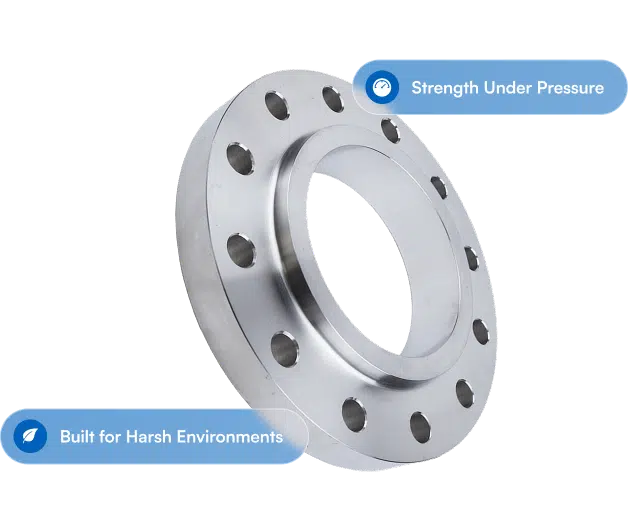
Hastelloy Flanges
Texas Flange supplies Hastelloy flanges from Pearland, Texas, and has sourced industrial flanges since 1986. We can source any commercially available Hastelloy grade. The grades requested most often are C-276, C-22, B-2, B-3, and X.
Hastelloy is a family of nickel alloys developed by Haynes International. The C grades are nickel-chromium-molybdenum alloys used in chemical processing, sour oilfield service, and seawater. The B grades are nickel-molybdenum alloys used in pure reducing acids. X is a nickel-chromium-iron-molybdenum alloy used where high-temperature strength and oxidation resistance matter.
For price and availability, send size, pressure class, facing, flange type, and grade to sales@texasflange.com or call 281-484-8325. You can also use the contact form. Availability and lead time are confirmed on each quote.
Related pages: alloy pipe flanges, Inconel and super duplex flanges, stainless steel flanges, carbon steel flanges, industrial flange catalog, dimensions and weights, and CAD and 3D drawings.
Hastelloy grades used for flanges
Nominal compositions below are from Haynes International. Purchase orders should call out the UNS number and the ASTM or AMS forging specification, not the trade name alone.
| Grade | UNS | Forging specification | Nominal composition (wt %, Haynes) | Typical service |
|---|---|---|---|---|
| C-276 | N10276 | ASTM B564 / ASME SB-564 | Ni balance, 16 Cr, 16 Mo, 5 Fe, 4 W, 2.5 Co max., 0.01 C max. | Chemical process equipment, sour oilfield environments, seawater and brine, mixed oxidizing and reducing acids |
| C-22 | N06022 | ASTM B564 / ASME SB-564 | Ni balance, 22 Cr, 13 Mo, 3 Fe, 3 W, 2.5 Co max., 0.01 C max. | Same alloy family as C-276, with higher chromium for oxidizing media such as wet chlorine and mixed nitric acids |
| B-2 | N10665 | ASTM B564 | Ni balance, 28 Mo (Haynes nominal) | Pure reducing acids, especially hydrochloric acid. Not for service with oxidizing impurities |
| B-3 | N10675 | ASTM B564 / ASME SB-564 | Ni balance, 28.5 Mo (Haynes nominal) | Same reducing-acid duty as earlier B-type alloys, with improved structural stability according to Haynes |
| X | N06002 | AMS 5754 | Ni balance, 22.0 Cr, 18.0 Fe, 9.0 Mo, 1.5 Co, 0.6 W, 0.1 C | High-temperature strength and oxidation resistance: industrial furnaces, gas-turbine combustion hardware, high-temperature process components |
Other commercially available grades, including C-4, C-2000, G-30, and G-35, can be quoted when the RFQ names them.
C-276 is the workhorse nickel-chromium-molybdenum grade and the one most often written into plant specifications. Haynes describes it as resistant to both oxidizing and non-oxidizing acids, to chloride pitting and crevice attack, and to sulfide stress cracking and stress corrosion cracking in sour oilfield environments.
C-22 belongs to the same family but has higher chromium (22% nominal versus 16%). Haynes states that this gives much higher resistance to oxidizing media than C-276, and a higher critical crevice temperature in ASTM G48 acidified ferric chloride tests (80°C for C-22 versus 55°C for C-276). See Hastelloy C-276 vs C-22 flanges: which to specify for the comparison.
B-2 and B-3 are different alloys. They are nickel-molybdenum grades with about 28% molybdenum and very little chromium, which is why they hold up in pure hydrochloric, hydrobromic, and sulfuric acids and why they are a poor choice if ferric salts, cupric salts, or wet chlorine may be present. Haynes positions B-3 as having improved structural stability compared with earlier B-type alloys. B-2 remains a commercially available grade and is still specified on many existing bills of material.
X is not a wet-corrosion substitute for C-276 or C-22. It is specified for oxidation resistance and strength at elevated temperature. Haynes lists forgings in X to AMS 5754, not to ASTM B564. If the RFQ says "Hastelloy flanges" and the duty is a furnace, afterburner, or similar high-temperature service, confirm that X (UNS N06002) is the intended grade and that AMS 5754 is acceptable.
Sizes, pressure classes, faces, and types
Hastelloy flanges are made to the same dimensional standards as other ASME pipe flanges:
- ASME B16.5 covers NPS 1/2 through 24 in Classes 150, 300, 400, 600, 900, 1500, and 2500. See also pipe flange pressure classes.
- ASME B16.47 covers NPS 26 through 60, Series A and Series B, in the classes listed in that standard (commonly 75, 150, 300, 400, 600, and 900).
Haynes lists C-276 and C-22 for use under ASME B16.5 (to 1250°F / 677°C for plate, forgings, and fittings) and lists X for use under ASME B16.5 (to 1500°F / 816°C). Pressure-temperature ratings come from the material group in the current ASME standard for that UNS number. Use the standard; do not take ratings from a supplier page.
Faces typically specified:
- Raised face (RF)
- Flat face (FF)
- Ring-type joint (RTJ)
See flange faces, ring joint flanges, and face finish. Gasket selection still matters; see how to select a flange gasket and flange gaskets.
Types we supply in these grades, subject to availability:
A short overview of flange types is on flange types basics. For sizes or geometries outside the standard tables, see custom flanges and large-diameter flanges. Dimension tables and drawings are on flange dimensions and weights and CAD and 3D flange drawings. The industrial flange catalog is the downloadable reference.
Typical services
Chemical processing. Haynes lists reactors, heat exchangers, and columns as typical chemical-process uses for C-276 and C-22. These grades are specified for mixed acid streams, chlorides, and process upsets that would attack stainless steel. See also petrochemical flanges.
Sour gas and oilfield service. Haynes states that C-276 is very resistant to sulfide stress cracking and stress corrosion cracking in sour oilfield environments, and lists both C-276 and C-22 against NACE MR0175 / ISO 15156. That listing is not the same as a finished flange automatically meeting the standard. Hardness, heat-treat condition, and product form have to match the current edition of NACE MR0175 / ISO 15156. If sour service is required, say so on the RFQ and send the project specification. Background is in our post on NACE MR0175 flanges for sour service. See also oil and gas industry flanges.
Seawater and brine. C-276 and C-22 are specified for seawater, brine, and other chloride-bearing waters because of their resistance to pitting, crevice corrosion, and chloride stress corrosion cracking. B-2 and B-3 are the wrong family for oxidizing seawater service.
Reducing acids. For pure hydrochloric, hydrobromic, or sulfuric acid, B-3 or B-2 is usually the grade to discuss, not C-276. Haynes warns that nickel-molybdenum alloys are hurt by oxidizing impurities in "real world" hydrochloric acid. If the acid may be contaminated, say so on the RFQ.
High temperature. X is specified for industrial furnace hardware and gas-turbine combustion-zone parts, and in some high-temperature chemical-process components such as retorts, muffles, and catalyst support grids. It is the wrong default for a wet corrosive process stream.
How to write the RFQ
Include, at a minimum:
- Grade and UNS number (for example, Hastelloy C-276, UNS N10276).
- Forging specification (ASTM B564 / ASME SB-564, or AMS 5754 for grade X).
- Standard, size, and class (ASME B16.5 or B16.47 Series A or B, NPS, pressure class).
- Flange type and facing, plus bore or schedule for weld necks.
- Quantity.
- Documentation: mill test reports are available. If you need EN 10204 3.1, positive material identification, NACE MR0175 / ISO 15156, or domestic origin (including Buy America or AIS), state that on the RFQ so it can be confirmed before we quote.
Send the inquiry to sales@texasflange.com, call 281-484-8325, or use the contact form.
Frequently asked questions
What is a Hastelloy flange?
Which Hastelloy grade should I specify?
What standards apply to Hastelloy flanges?
Can Hastelloy flanges be used in sour service or seawater?
Do you supply grades other than C-276 and C-22?
How do I get a quote for Hastelloy flanges?
Trademark
Hastelloy, C-22, and B-3 are registered trademarks of Haynes International, Inc. Texas Flange is not affiliated with Haynes International. Grade names on this page identify the alloy family and the matching UNS numbers. Material is supplied to the ASTM, ASME, or AMS specification stated on the purchase order.
References
- Haynes International, HASTELLOY C-276 (UNS N10276): composition, corrosion features, ASTM B564 forgings, NACE MR0175 / ISO 15156, ASME B16.5 listing.
- Haynes International, HASTELLOY C-22 (UNS N06022): composition, oxidizing-media comparison with C-276, ASTM G48 crevice data, ASTM B564 forgings, NACE MR0175, ASME B16.5 listing.
- Haynes International, HASTELLOY B-3 (UNS N10675): reducing-acid resistance, structural stability versus earlier B-type alloys, ASTM B564 forgings.
- Haynes International, HASTELLOY X (UNS N06002): composition, high-temperature uses, AMS 5754 forgings, ASME B16.5 listing.
- Haynes International, Alloy nominal compositions and specifications for corrosion-resistant alloys.
- Haynes International, Corrosive environments (nickel-molybdenum alloys and oxidizing impurities in hydrochloric acid).
- Haynes International, C-22 and C-276 in saturated wet chlorine.
- ASTM International, Standard Specification for Nickel Alloy Forgings (B564). Public scope includes UNS N10276, N06022, N10665, and N10675.
- ASME, B16.5 Pipe Flanges and Flanged Fittings, NPS 1/2 Through NPS 24.
- ASME, B16.47 Large Diameter Steel Flanges, NPS 26 Through NPS 60.