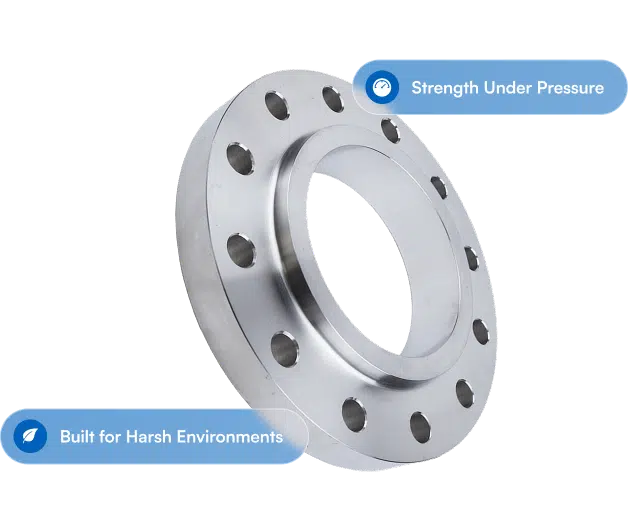
C-276 and C-22 are the two Hastelloy grades that show up most often on flange bills of material. Both are nickel-chromium-molybdenum alloys. Both are forged to ASTM B564 (ASME SB-564). Both are used for ASME B16.5 and B16.47 flanges in chemical processing, sour service, and chloride-bearing waters. They are not interchangeable.
The short version: C-276 (UNS N10276) is the workhorse and the grade already written into most plant specifications. C-22 (UNS N06022) has more chromium and is the better choice when the environment is oxidizing, or when it may swing between oxidizing and reducing. Haynes International, which owns the Hastelloy trademarks, states that the higher chromium content of C-22 "provides much higher resistance to oxidizing media than the family standard, C-276 alloy."
To request parts, see Hastelloy flanges or email size, class, facing, type, and grade to sales@texasflange.com.
How the two alloys differ
Haynes publishes these nominal compositions. The purchase order should still require a mill test report against the ASTM chemistry for the UNS number, not the trade name alone.
| C-276 (UNS N10276) | C-22 (UNS N06022) | |
|---|---|---|
| Nickel | Balance (57 nominal) | Balance (56 nominal) |
| Chromium | 16 | 22 |
| Molybdenum | 16 | 13 |
| Tungsten | 4 | 3 |
| Iron | 5 | 3 |
| Carbon | 0.01 max. | 0.01 max. |
| Forgings | ASTM B564 / ASME SB-564 | ASTM B564 / ASME SB-564 |
| ASME B16.5 (Haynes listing) | Yes, to 1250°F (677°C) for plate, forgings, and fittings | Yes, to 1250°F (677°C) for plate, forgings, and fittings |
| NACE MR0175 / ISO 15156 (Haynes listing) | Listed | Listed |
The useful difference is the chromium-to-molybdenum balance. Chromium helps in oxidizing acids (nitric acid, wet chlorine, ferric and cupric salts). Molybdenum and tungsten help in reducing acids (hydrochloric acid and dilute sulfuric acid). C-22 was designed to keep enough molybdenum and tungsten for reducing service while raising chromium for oxidizing service. That is why Haynes presents it as the more versatile of the two when a process is not purely reducing.
Oxidizing service, including wet chlorine
If the stream includes wet chlorine, chlorine dioxide, hypochlorite, nitric acid mixed with chlorides, or other oxidizing species, C-22 is usually the grade to evaluate first.
Haynes compared the two alloys in saturated wet chlorine (a 3,000 ppm chloride solution acidified with HCl, with chlorine gas bubbled through the solution). In those tests, C-276 showed weld-metal and heat-affected-zone attack in the vapor phase at 65°C and in the liquid at 80°C. C-22 did not show localized attack in the liquid at 95°C or in the vapor at 90°C. Haynes concluded that C-22 is significantly more resistant to wet chlorine than C-276.
A flanged joint often sits at a liquid-vapor interface, in a scrubber, or in a bleach circuit — the kind of duty in those tests. Texas Flange does not weld flanges; the fabricator joining the matching pipe will still care about the same heat-affected-zone behavior.
Pitting and crevice corrosion
Both grades resist chloride pitting and crevice corrosion far better than 316L or even 6% molybdenum stainless. In ASTM G48 tests in acidified 6% ferric chloride, Haynes reports a critical crevice temperature of 55°C (131°F) for C-276 and 80°C (176°F) for C-22. Critical pitting temperatures for both are at or above 150°C (302°F) in that solution.
The crevice number is the one to notice on a flange. A raised-face or RTJ joint, a gasket groove, and the area under a bolt head are crevices. If the design temperature in a chloride fluid sits between those two critical crevice temperatures, C-22 is the more conservative of the two C grades.
Both alloys also resist chloride stress corrosion cracking in conditions that crack austenitic stainless steel. Haynes reports no cracking of C-276 or C-22 U-bends in boiling 45% magnesium chloride (ASTM G36) out to 1,008 hours, while 316L cracked in two hours.
Reducing acids and mixed process streams
In pure, reducing hydrochloric or sulfuric acid, both C grades are a large step up from stainless steel. Haynes' iso-corrosion data for hydrochloric acid show a sharp improvement over 316L and 254SMO above about 5% HCl for both C-276 and C-22.
C-276 has the longer service record in chemical plants and is often already in a site's materials standard. That is a sound reason to stay with it when the duty is a known, reducing stream and the specification already names it.
C-22 should not be dismissed in reducing service just because it has slightly less molybdenum (13% nominal versus 16%). Haynes still rates it for both oxidizing and non-oxidizing chemicals. The usual question is whether the process stays reducing, or whether it can be upset with air, chlorine, ferric ion, or a nitric cleaning step. If an upset is plausible, C-22 is the grade designed for that swing.
If the duty is pure hydrochloric, hydrobromic, or sulfuric acid with no oxidizers, neither C grade may be the first choice. The B-type alloys (B-2, UNS N10665, and B-3, UNS N10675) are the nickel-molybdenum grades Haynes describes for that service. They are a poor choice if oxidizing impurities are present. Those grades, and high-temperature grade X, are covered on the Hastelloy flanges page.
Sour service
Haynes states that C-276 is very resistant to sulfide stress cracking and stress corrosion cracking in sour oilfield environments, and lists both C-276 and C-22 against NACE MR0175 / ISO 15156.
That is not a blanket certificate for every flange. Acceptance depends on product form, heat-treat condition, hardness, and the current text of NACE MR0175 / ISO 15156. If the line is sour, put NACE MR0175 / ISO 15156 on the RFQ and send the project specification with it. For the background on what the standard is asking for, see NACE MR0175 flanges for sour service.
Availability
C-276 is the more commonly specified of the two, which usually makes it the easier grade to source. Specify C-22 when the corrosion advantage in oxidizing or mixed service is needed. We do not publish a stock list or a standard price adder; both move with size, class, and quantity and are confirmed at quote.
Texas Flange has sourced industrial flanges from Pearland, Texas, since 1986 and can source either grade, or other commercially available Hastelloy grades, when they are on the market.
How to write the specification
A complete flange callout leaves little to interpret:
- Grade and UNS number: Hastelloy C-276, UNS N10276, or Hastelloy C-22, UNS N06022.
- Forging specification: ASTM B564 / ASME SB-564.
- Dimensional standard: ASME B16.5 for NPS 1/2 through 24, or ASME B16.47 Series A or Series B for NPS 26 through 60.
- Pressure class, flange type, and facing (RF, FF, or RTJ), plus bore or schedule for weld necks.
- Documentation: mill test reports are available. Add EN 10204 3.1, PMI, NACE MR0175 / ISO 15156, or domestic origin if the job requires them.
Pressure-temperature ratings come from the material group in the current ASME B16.5 or B16.47 standard, not from a catalog page. Haynes lists both alloys for B16.5 use to 1250°F (677°C) for plate, forgings, and fittings. Use the standard for the numbers.
Related pages: Hastelloy flanges, alloy pipe flanges, dimensions and weights, CAD and 3D drawings, and the industrial flange catalog.
To request a quote, email sales@texasflange.com, call 281-484-8325, or use the contact form.
Trademark
Hastelloy and C-22 are registered trademarks of Haynes International, Inc. Texas Flange is not affiliated with Haynes International. Grade names in this article identify the alloy family and the matching UNS numbers. Material is supplied to the ASTM or ASME specification stated on the purchase order.
References
Haynes International: C-276, C-22 (including ASTM G48 and G36 data), wet-chlorine comparison, nominal compositions, and alloy specifications. ASTM International, B564. ASME, B16.5 and B16.47.