On the night of January 16, 1943, the tanker SS Schenectady was sitting quietly at her fitting-out dock in Portland, Oregon. The sea was calm. The ship was barely a day old. And then, with a bang witnesses heard a mile away, she cracked almost completely in two. The catastrophic fracture ran up both the port and starboard sides, deep through the middle of the bridge, forcing the bow and stern to tilt into the water. Nobody had touched her. It was simply a cold, quiet winter evening.
That failure, and dozens like it across the WWII Liberty ship fleet, rewrote how engineers think about steel. The lesson learned here didn’t apply to seafaring alone, but to material engineering across the board. It is baked into the material line of every cold-service pipe and flange spec written today, and it is worth understanding before you sign off on one for your own assembly’s operations.
The Ships That Broke Without Warning
The United States built roughly 2,700 Liberty ships during the war, welded and assembled together quickly by a workforce that had never built a ship spec of this magnitude before. Speed was the point, because the timing of WWII deemed it necessary. The problem of material failure eventually manifested in the cold, for everyone to see. Of those 2,700 hulls, around 400 developed fractures, about 90 of them serious, and a number of them unfortunately broke clean in two. Almost every catastrophic failure happened in winter, in the icy northern waters.
Two factors combined to reveal this problem. First, the stees; the plate chemistry of the era ran high in sulfur and low in manganese, which left it prone to its brittle properties when the temperature dropped. Second, the all-welded construction; older ships were typically riveted, and a crack running through a riveted hull tends to stop when it reaches the seam between two overlapping plates, leaving a bit of a stopping point for structural failure. In a welded hull, the plates are fused into one continuous piece of metal, so a crack that starts at a stress riser, like the square corner of a deck hatch, has nothing to prevent it from spreading. It runs the length of the ship as the pressure from each side builds to tear it.
The investigations that followed launched the entire discipline of fracture mechanics. You might hear about this science today in your daily life if you cross a steel and concrete bridge to get to work, or perhaps you read about something similar regarding the brittle failure of a component in the Space Shuttle Challenger launch disaster. One finding which still shows up in steel specifications today for engineers to consider: brittle failures clustered where the steel's Charpy impact energy fell below about 15 foot-pounds.
What Brittle Fracture Actually Is
Most steel failures give you a warning before the failure manifests completely. The metal yields, stretches, and visibly deforms before it lets go. That is ductile behavior, and it is what we count on. Brittle fracture, unfortunately, isn’t so forgiving. The steel behaves elastically right up to the moment it shatters, with no stretching, no necking, no warning. In one moment it’s holding, and the next it’s in two pieces, before you have time to do anything about it.
What flips a steel’s primary physical consideration from ductile to brittle is temperature. Carbon and low-alloy steels have a ductile-to-brittle transition temperature, a point on the thermometer below which the same metal that was tough and forgiving becomes glassy and crack-prone. Above the transition, a flaw is just a flaw. Below it, that flaw is a crack waiting for a reason to run. The Schenectady's steel was perfectly adequate at room temperature. On a freezing night in January, it was below its transition, and a minor stress concentration was all it took for catastrophic failure.
This is why "strong" and "tough" are not the same word in material science, and metallurgists are aware enough to make the distinction. A material can have plenty of tensile strength and still fail brittle in the cold. Strength is how hard you can “pull” on it. Toughness is whether it cracks or bends when it is cold and there is a notch present.
Why This Consideration Exists in Your Flange Spec
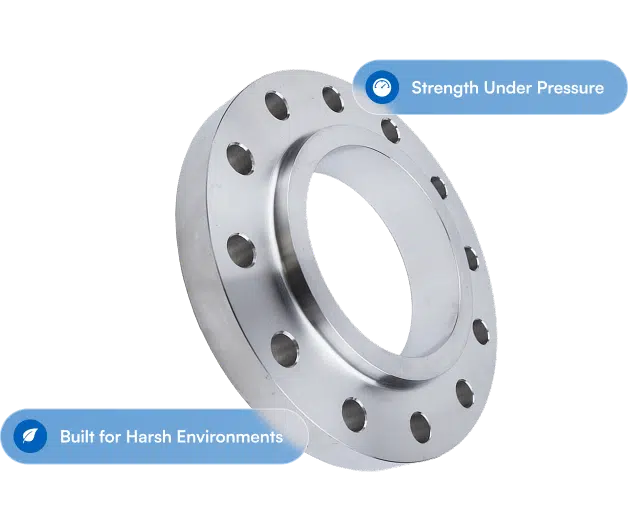
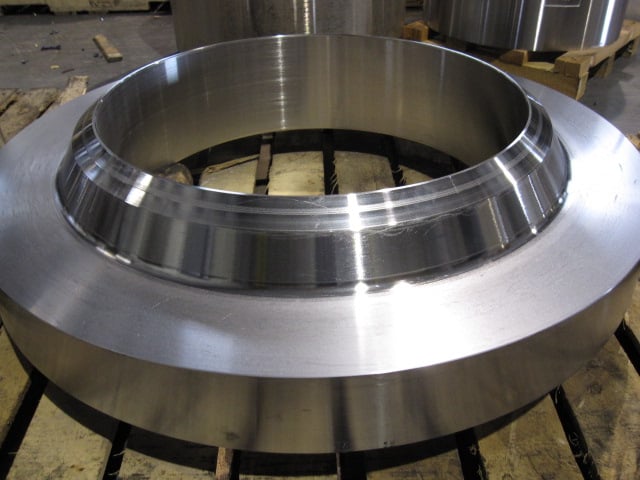
Here is the connection to your application: Standard forged carbon steel flange material, ASTM A105, has a ductile-to-brittle transition like any other carbon steel. It is an excellent, economical choice for ambient and elevated temperatures, which covers most process service. Take it well below freezing, and you are walking toward the same cliff the Liberty ships went over. For that reason, A105 is generally limited to about -20°F in pressure piping unless it has been impact tested. Further below, and you need “superior” cold service.
When the service runs well below freezing, the spec changes to a grade that has been proven tough at lower temperature:
Material | Typical Low-Temp Limit | How Toughness Is Verified |
ASTM A105 (forged carbon steel) | About -20°F without testing | Impact testing required to go colder |
ASTM A350 LF2 | Down to -50°F | Charpy V-notch impact tested at -50°F |
ASTM A350 LF3 | Down to -150°F | Charpy V-notch impact tested at and up to -150°F for severity |
Austenitic stainless (A182 F304/F316) | Cryogenic | Austenitic grain structure stays tough; testing per spec |
This pattern is the same one the Navy recognized in 1943. You do not select cold-service material on strength alone. You select it on verified toughness at the lowest temperature the metal will actually see in general service, including upset and ambient conditions, and not just the normal operating temperature. The grade choice between A105 and a low-temp grade is exactly the decision our A105 vs. A350 LF2 comparison walks through, and our carbon steel flange page lays out the low-temp options.
The proof is on paper. When a job calls for low-temperature service, the impact testing shows up as a supplementary requirement on the Material Test Report, with the actual Charpy values and test temperature recorded. If the MTR does not show it, the toughness was never verified, no matter what the grade stamp says. Check the raw material if need be as well, but the final MTR should tell you what you need to know.
The Lesson, Eighty Years On
The Liberty ships are a museum-piece story, but the physics have not changed. Carbon steel that is rock solid in the typical Houston heat can be brittle on a cold morning in North Dakota, and a flange that flunks on brittleness requirements fails the way the Schenectady did: all at once, without warning. Therefore, know in advance the minimum metal temperature, then spec a grade with verified low-temperature toughness, and confirm the impact testing on the MTR before it ships and is installed.
If you have a cold-service application and want to make sure the flange material is specified and documented for the temperature it will actually see, send us the details. We will get you the right grade with the impact testing on the certifications, so your joint never has a 1943 type moment. No one wants their own Titanic.
Texas Flange & Fitting Supply | 281-484-8325 | texasflange.com