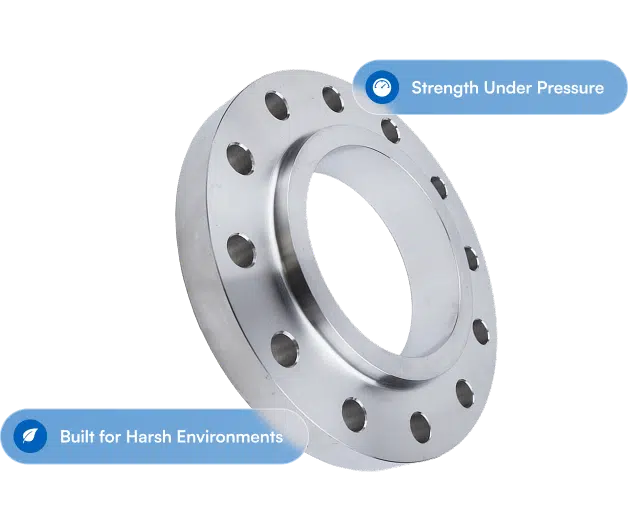
ASME B16.5 covers pipe flanges and flanged fittings from 1/2 inch through 24 inch in Class 150, 300, 400, 600, 900, 1500, and 2500. It defines pressure-temperature ratings, materials, dimensions, tolerances, marking, and testing. For dimensions by size, start with our ASME B16.5 Class 150 flange dimensions.
The rating tables below give maximum allowable working pressure for each material group at temperature. For flanges above 24 inch, see ASME B16.47 Series A and Series B.
The standards and codes help to determine the characteristics of pressure integrity and simplify the design rules.
The difference between the codes and standards is helpful for the designers with detailed flange specifications and designs for the components. Here are the frequently encountered rules and standards:
Structural behavior is due to the effects of thermal expansion, live loads, seismic loads, deadweight, internal pressure, and other imposed external or internal loads.
However, the piping codes provide no design rules for standard in-line components like standard valves and flange fitting components. The designing of these classes of elements happens through the reference to the industry standards.
1. Pressure-integrity standards: The standards help in providing uniform minimum-performance criteria. The designing and manufacturing of the components to the same standards will be helpful to function equivalently.
It helps to remember that pressure integrity is not entirely synonymous with leakage integrity.
During the operation and test, pressure integrity is one assurance when it comes to the leak-tight condition and does not account for the entire risk profile to the structural stability of the pressure boundary or added stresses.
2. Dimensional standards: The standards define the configurations and parameters for piping components, ensuring parts from different manufacturers are physically interchangeable. This consistency is essential for maintaining compatibility across systems.
However, meeting ASME flange dimensional standards doesn’t guarantee identical performance among similar products. Various ASME standards also include pressure-temperature ratings, which help determine the suitability of components for specific applications.
ASME B16.5-2025 assigns every listed material to a numbered material group, and every material in a group shares one pressure-temperature rating table. The complete material list and every rating table are in ASME B16.5-2025, Pipe Flanges and Flanged Fittings.
The flanges with any material in the same group can easily carry the same pressure class of ASME flange and have the same pressure-temperature rating for almost any single material group.
The ASME B16.5 standard provides the 7 pressure classes for flanges. These are – 2500, 1500, 900, 600, 400 (less common today), 300 and 150. Class 75 also exists in ASME B16.47 Series B large diameter. Our Class 300 dimensions and weights table covers the next class up.
Each material group has its own pressure-temperature rating table in ASME B16.5-2025. The full list of Group 1 and Group 2 materials is below, followed by rating tables for the three groups behind most forged flange orders: Group 1.1 (carbon steel, A105 and A350 LF2), Group 2.1 (F304 and F304H) and Group 2.2 (F316, F316H and F317).
The tables you will find below are organized as per the pressure classes that you can find at the top. At the left-hand border, you can also find the maximum working temperatures.
During the practice, using ASME B16.5 to determine the rating of the flange is relatively easy. Below is the recommended three-step process:
a. Determine the maximum temperature and operating pressure required for the flange.
b. Find your flange material in the material-group table below and note its group. Each rating table also repeats the materials it covers, with numbered notes: several materials carry a maximum service temperature that can change the selection.
c. Go to that group's rating table and start at the first listed temperature at or above your maximum operating temperature.
Try to start with the Class 150 column and then proceed to the right until you find the proper pressure rating for the desired temperature, exceeding or equal to the required operating pressure.
The specified column that can satisfy the requirements can dictate the required pressure class and determine the actual pressure-temperature rating of the flange.
ASTM A182 Gr. F316 is a Material Group 2.2 forging.
In the Group 2.2 rating table below, a Class 600 flange is rated 885 psig at 650°F. See our Class 600 dimensions and weights for that flange.
Which rating table applies to your material
Every material listed in ASME B16.5 belongs to a numbered material group, and every material in a group shares one pressure-temperature rating table. Find your specification below, note the group, then read that group's rating table.
ASME B16.5 material groups, Group 1 (carbon and low-alloy steel) and Group 2 (stainless and duplex)
Material group
Nominal designation
Forgings
Castings
Plates
1.1
C–Si
A105
A216 Gr. WCB
A515 Gr. 70
C–Mn–Si
A350 Gr. LF2
…
A516 Gr. 70
C–Mn–Si
…
…
A537 Cl. 1
C–Mn–Si–V
A350 Gr. LF6 Cl. 1
…
…
3½Ni
A350 Gr. LF3
…
…
1.2
C–Mn–Si
…
A216 Gr. WCC
…
C–Mn–Si
…
A352 Gr. LCC
…
C–Mn–Si–V
A350 Gr. LF6 Cl. 2
…
…
2½Ni
…
A352 Gr. LC2
A203 Gr. B
3½Ni
…
A352 Gr. LC3
A203 Gr. E
1.3
C–Si
…
A352 Gr. LCB
A515 Gr. 65
C–Mn–Si
…
…
A516 Gr. 65
2½Ni
…
…
A203 Gr. A
3½Ni
…
…
A203 Gr. D
C–½Mo
…
A217 Gr. WC1
…
C–½Mo
…
A352 Gr. LC1
…
1.4
C–Si
…
…
A515 Gr. 60
C–Mn–Si
A350 Gr. LF1 Cl. 1
…
A516 Gr. 60
1.5
C–½Mo
A182 Gr. F1
…
A204 Gr. A
C–½Mo
…
…
A204 Gr. B
1.7
½Cr–½Mo
A182 Gr. F2
…
…
Ni–½Cr–½Mo
…
A217 Gr. WC4
…
¾Ni–¾Cr–1Mo
…
A217 Gr. WC5
…
1.9
1¼Cr–½Mo
…
A217 Gr. WC6
…
1¼Cr–½Mo–Si
A182 Gr. F11 Cl. 2
…
A387 Gr. 11 Cl. 2
1.10
2¼Cr–1Mo
A182 Gr. F22 Cl. 3
A217 Gr. WC9
A387 Gr. 22 Cl. 2
1.11
3Cr–1Mo
A182 Gr. F21
…
A387 Gr. 21 Cl. 2
C–½Mo
…
…
A204 Gr. C
1.13
5Cr–½Mo
A182 Gr. F5a
A217 Gr. C5
…
1.14
9Cr–1Mo
A182 Gr. F9
A217 Gr. C12
…
1.15
9Cr–1Mo–V
A182 Gr. F91 Type 1
A217 Gr. C12A
A387 Gr. 91 Cl. 2
1.17
1Cr–½Mo
A182 Gr. F12 Cl. 2
…
…
5Cr–½Mo
A182 Gr. F5
…
…
1.18
9Cr–2W–V
A182 Gr. F92
…
…
2.1
18Cr–8Ni
A182 Gr. F304
A351 Gr. CF3
A240 Gr. 304
18Cr–8Ni
A182 Gr. F304H
A351 Gr. CF8
A240 Gr. 304H
2.2
16Cr–12Ni–2Mo
A182 Gr. F316
A351 Gr. CF3M
A240 Gr. 316
16Cr–12Ni–2Mo
A182 Gr. F316H
A351 Gr. CF8M
A240 Gr. 316H
18Cr–13Ni–3Mo
A182 Gr. F317
…
A240 Gr. 317
19Cr–10Ni–3Mo
…
A351 Gr. CG8M
…
2.3
18Cr–8Ni
A182 Gr. F304L
…
A240 Gr. 304L
16Cr–12Ni–2Mo
A182 Gr. F316L
…
A240 Gr. 316L
18Cr–13Ni–3Mo
A182 Gr. F317L
…
…
2.4
18Cr–10Ni–Ti
A182 Gr. F321
…
A240 Gr. 321
18Cr–10Ni–Ti
A182 Gr. F321H
…
A240 Gr. 321H
2.5
18Cr–10Ni–Cb
A182 Gr. F347
…
A240 Gr. 347
18Cr–10Ni–Cb
A182 Gr. F347H
…
A240 Gr. 347H
18Cr–10Ni–Cb
A182 Gr. F348
…
A240 Gr. 348
18Cr–10Ni–Cb
A182 Gr. F348H
…
A240 Gr. 348H
2.6
23Cr–12Ni
…
…
A240 Gr. 309H
2.7
25Cr–20Ni
A182 Gr. 310H
…
A240 Gr. 310H
2.8
20Cr–18Ni–6Mo
A182 Gr. F44
A351 Gr. CK3MCuN
A240 Gr. S31254
2.9
23Cr–12Ni
…
…
A240 Gr. 309S
25Cr–12Ni
…
…
A240 Gr. 310S
2.10
25Cr–12Ni
…
A351 Gr. CH8
…
25Cr–12Ni
…
A351 Gr. CH20
…
2.11
18Cr–10Ni–Cb
…
A351 Gr. CF8C
…
2.12
25Cr–20Ni
…
A351 Gr. CK20
…
2.13
22Cr–5Ni–3Mo–N
A182 Gr. F51
A995 Gr. CD3MN (4A)
A240 Gr. S31803
22Cr–5Ni–3Mo–N
A182 Gr. F60
…
…
22Cr–5Ni–3Mo–N
…
…
A240 Gr. S32205
25Cr–5Ni–3Mo–2Cu
…
…
A240 Gr. S32550
25Cr–7Ni–4Mo–N
A182 Gr. F53
…
A240 Gr. S32750
24Cr–10Ni–4Mo–V
…
A995 Gr. CE8MN (2A)
…
25Cr–5Ni–2Mo–3Cu–N
…
A995 Gr. CD4MCuN (1B)
…
25Cr–7Ni–3.5Mo–W–Cb
…
A995 Gr. CD3MWCuN (6A)
…
25Cr–7Ni–3.5Mo–N–Cu–W
A182 Gr. F55
…
A240 Gr. S32760
ASME BPVC Section II materials may also be used, provided the requirements of the ASME specification are identical to or more stringent than the corresponding ASTM specification for the Grade, Class or Type listed. For temperature limitations, see the notes under each rating table. Plate materials are listed only for use as blind flanges and reducing flanges without hubs.
Groups 1 and 2 are shown. ASME B16.5-2025 also lists Group 3 nickel-alloy materials, which are rated in their own tables.
Source: ASME B16.5-2025, Pipe Flanges and Flanged Fittings, American Society of Mechanical Engineers, New York. List of material specifications, pp. 5–6.
Material Group 1.1: carbon steel (A105, A350 LF2, A216 WCB)
Material Group 1.1, specifications covered by this rating table
Nominal designation
Forgings
Castings
Plates
C–Si
A105 (1)(2)
A216 Gr. WCB (1)
A515 Gr. 70 (1)
C–Mn–Si
A350 Gr. LF2 (1)
…
A516 Gr. 70 (1)(3)
C–Mn–Si
…
…
A537 Cl. 1 (4)
C–Mn–Si–V
A350 Gr. LF6 Cl. 1 (3)
…
…
3½Ni
A350 Gr. LF3 (5)
…
…
Working pressure by class, psig, Material Group 1.1
Temp., °F
150
300
400
600
900
1500
2500
Min. to 100
285
740
985
1,480
2,220
3,705
6,170
200
260
680
905
1,360
2,035
3,395
5,655
300
230
655
870
1,310
1,965
3,270
5,450
400
200
635
845
1,265
1,900
3,170
5,280
500
170
605
805
1,205
1,810
3,015
5,025
600
140
570
755
1,135
1,705
2,840
4,730
650
125
550
730
1,100
1,650
2,745
4,575
700
110
530
710
1,060
1,590
2,655
4,425
750
95
505
675
1,015
1,520
2,535
4,230
800 *
80
410
550
825
1,235
2,055
3,430
850 *
65
320
425
640
955
1,595
2,655
900 *
50
230
305
460
690
1,150
1,915
950 *
35
135
185
275
410
685
1,145
1,000 *
20
85
115
170
255
430
715
* Group 1.1 notes. (1) Prolonged use above 800°F is permissible but not recommended: prolonged exposure above 800°F may cause the carbide phase of steel to convert to graphite. (2) Only killed steel shall be used above 850°F. (3) Not to be used over 500°F. (4) Not to be used over 700°F. (5) Not to be used over 650°F.
† Linear interpolation between listed temperatures is permitted. To convert psig to kPa gage, multiply by 6.895.
‡ The low end of the "Min. to 100" row is not one number for every material. ASME B16.5-2025 gives guidance for determining minimum temperatures and lists example minimum use temperatures in its nonmandatory appendix.
Source: ASME B16.5-2025, Pipe Flanges and Flanged Fittings, American Society of Mechanical Engineers, New York. Pressure–temperature ratings for Group 1.1 materials, U.S. customary units, p. 26.
Material Group 2.1: 18Cr–8Ni austenitic stainless (F304, F304H)
Material Group 2.1, specifications covered by this rating table
Nominal designation
Forgings
Castings
Plates
18Cr–8Ni
A182 Gr. F304 (1)
A351 Gr. CF3 (2)
A240 Gr. 304 (1)
18Cr–8Ni
A182 Gr. F304H
A351 Gr. CF8 (1)
A240 Gr. 304H
Working pressure by class, psig, Material Group 2.1
Temp., °F
150
300
400
600
900
1500
2500
Min. to 100
275
720
960
1,440
2,160
3,600
6,000
200
230
600
800
1,200
1,800
3,000
5,000
300
205
540
715
1,075
1,615
2,690
4,480
400
190
495
660
990
1,485
2,470
4,120
500
170
465
620
925
1,390
2,315
3,860
600
140
440
590
885
1,325
2,210
3,680
650
125
430
575
860
1,290
2,150
3,580
700
110
420
565
845
1,265
2,110
3,520
750
95
415
550
825
1,240
2,065
3,440
800
80
405
540
810
1,215
2,030
3,380
850
65
395
530
790
1,190
1,980
3,300
900
50
390
520
780
1,165
1,945
3,240
950
35
380
510
765
1,145
1,910
3,180
1,000 *
20
355
475
715
1,070
1,785
2,970
1,050 *
…
325
435
650
975
1,630
2,715
1,100 *
…
255
345
515
770
1,285
2,145
1,150 *
…
205
275
410
615
1,030
1,715
1,200 *
…
165
220
330
495
825
1,370
1,250 *
…
135
180
265
400
670
1,115
1,300 *
…
115
150
225
340
565
945
1,350 *
…
95
125
185
280
465
770
1,400 *
…
80
105
160
235
395
655
1,450 *
…
60
80
125
185
310
515
1,500 *
…
50
65
95
145
245
400
* Group 2.1 notes. (1) At temperatures over 1,000°F, use only when the carbon content is 0.04% or higher. (2) Not to be used over 800°F.
† Linear interpolation between listed temperatures is permitted. To convert psig to kPa gage, multiply by 6.895.
‡ The low end of the "Min. to 100" row is not one number for every material. ASME B16.5-2025 gives guidance for determining minimum temperatures and lists example minimum use temperatures in its nonmandatory appendix.
Source: ASME B16.5-2025, Pipe Flanges and Flanged Fittings, American Society of Mechanical Engineers, New York. Pressure–temperature ratings for Group 2.1 materials, U.S. customary units, p. 54.
Material Group 2.2: 16Cr–12Ni–2Mo austenitic stainless (F316, F316H, F317)
Material Group 2.2, specifications covered by this rating table
Nominal designation
Forgings
Castings
Plates
16Cr–12Ni–2Mo
A182 Gr. F316 (1)
A351 Gr. CF3M (2)
A240 Gr. 316 (1)
16Cr–12Ni–2Mo
A182 Gr. F316H
A351 Gr. CF8M (1)
A240 Gr. 316H
18Cr–13Ni–3Mo
A182 Gr. F317 (1)
…
A240 Gr. 317 (1)
19Cr–10Ni–3Mo
…
A351 Gr. CG8M (3)
…
Working pressure by class, psig, Material Group 2.2
Temp., °F
150
300
400
600
900
1500
2500
Min. to 100
275
720
960
1,440
2,160
3,600
6,000
200
235
620
825
1,240
1,860
3,095
5,160
300
215
560
745
1,120
1,680
2,795
4,660
400
195
515
685
1,025
1,540
2,570
4,280
500
170
480
635
955
1,435
2,390
3,980
600
140
450
600
900
1,355
2,255
3,760
650
125
440
590
885
1,325
2,210
3,680
700
110
435
580
870
1,305
2,170
3,620
750
95
425
570
855
1,280
2,135
3,560
800
80
420
565
845
1,265
2,110
3,520
850
65
420
555
835
1,255
2,090
3,480
900
50
415
550
825
1,240
2,065
3,440
950
35
410
545
815
1,225
2,040
3,400
1,000 *
20
385
515
775
1,160
1,935
3,230
1,050 *
…
385
510
770
1,150
1,920
3,200
1,100 *
…
305
405
610
915
1,525
2,545
1,150 *
…
235
315
475
710
1,185
1,970
1,200 *
…
185
245
370
555
925
1,545
1,250 *
…
145
195
295
440
735
1,230
1,300 *
…
115
155
235
350
585
970
1,350 *
…
95
130
190
290
480
800
1,400 *
…
80
105
160
235
395
655
1,450 *
…
60
80
115
175
290
485
1,500 *
…
45
60
90
135
225
370
* Group 2.2 notes. (1) At temperatures over 1,000°F, use only when the carbon content is 0.04% or higher. (2) Not to be used over 850°F. (3) Not to be used over 1,000°F.
† Linear interpolation between listed temperatures is permitted. To convert psig to kPa gage, multiply by 6.895.
‡ The low end of the "Min. to 100" row is not one number for every material. ASME B16.5-2025 gives guidance for determining minimum temperatures and lists example minimum use temperatures in its nonmandatory appendix.
Source: ASME B16.5-2025, Pipe Flanges and Flanged Fittings, American Society of Mechanical Engineers, New York. Pressure–temperature ratings for Group 2.2 materials, U.S. customary units, p. 56.
Ratings are for flanges and flanged fittings built to ASME B16.5 and apply to the
flange itself, not to the bolting or the gasket. The joint is only rated to the
weakest of the three. Class 400 is included here because it is part of the standard,
even though it is rarely stocked. To find the table that applies to a material, look
it up in the material-group table above each rating table: A105 and A350 LF2 are
Group 1.1, F304 and F304H are Group 2.1, F316, F316H and F317 are Group 2.2.