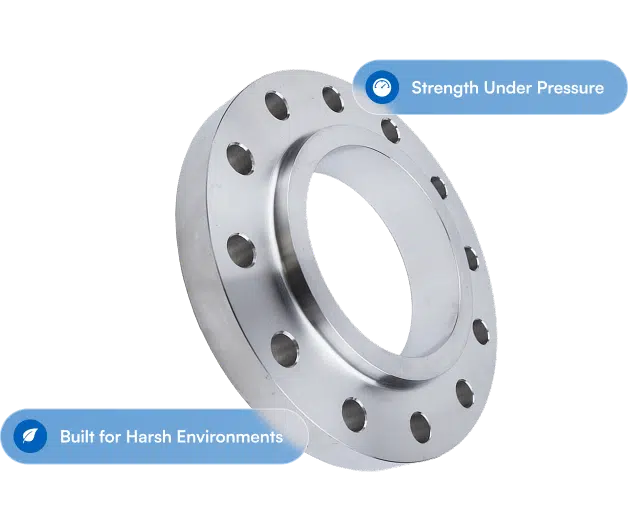
Pull a flange off da rack and look at da outer edge. On a properly made one you gonna find a cluster of letters and numbers stamped into da steel: a logo, a few abbreviations, a long number dat looks like a serial code. Most folks in da field can read about half of it on instinct and guess at da rest. Dat guessin’ is where trouble starts, friend, because every one of dose marks is tellin’ you somet'ing specific about what you're holdin’.
Dis is da companion question to a piece we ran recently. If your flange has no stamp at all, start with our field guide to identifying unmarked flanges. Dis post is da opposite situation: da marks are right dere, and you want to know exactly what dey mean. Here is how to read flange markings, line by line.
What the Standard Actually Requires
Flange marking is not left to da manufacturer's preference. ASME B16.5 ties its marking provisions to MSS SP-25, da Standard Marking System for Valves, Fittings, Flanges, and Unions. Dat standard spells out what has to appear on da part and roughly where it goes.
Da marks you should expect to find on any legitimate forged flange are da manufacturer's name or trademark, da material designation, da pressure class, and a heat number for traceability. On larger and special-service flanges you gonna see more, but dose four are da backbone. Dey almost always sit on da outside diameter, on da face opposite da raised face. On weld neck flanges dey occasionally land on da hub instead.
If a flange is missin’ all of dese, dat is a red flag worth takin’ serious. A blank flange has no traceable history, and no MTR to tie it back to. Decode what is present first, den decide whether what is missin’ is a dealbreaker for your service.
Decoding the Material Marking
Da material mark is da one folks misread most often, and it is da one dat matters most. Start with da prefix.
You gonna see grades stamped as either "A105" or "SA-105." Dey are da same steel. ASME adopts ASTM material specs into Section II of its Boiler and Pressure Vessel Code and adds an "S" to da front. So SA-105 is chemically and mechanically identical to ASTM A105 forged carbon steel. Da difference is paperwork and intent: SA-grade material is certified for ASME code pressure-vessel work, while da A-grade designation shows up on general process piping built to B31.1 or B31.3. If your job is code-stamped vessel work, dat single letter is da difference between an acceptable part and a rejected one.
After da prefix comes da grade symbol. A few you gonna run into constantly:
A105 is forged carbon steel, da default for ambient-temperature process service. A182 covers da alloy and stainless forgings, and da grade follows as an F-number: F304, F316, F11, F22, F91. An "L" suffix means low carbon, so F316L is da low-carbon version of F316, which matters for corrosion resistance and weldin’. A350 LF2 is da low-temperature carbon grade, impact-tested for cold service. When you see "LF" anywhere on da stamp, t'ink low temperature.
Da grade tells you da steel. It does not tell you da heat treatment or da actual chemistry of dat specific part. Dat is what da heat number is for.
Pressure Class, Size, and the Numbers
Da pressure class is da easy one. ASME B16.5 flanges are marked with one of seven class designations: 150, 300, 400, 600, 900, 1500, or 2500. Dat number is da class, not a pressure in PSI. A Class 150 flange does not hold 150 PSI; its actual pressure rating depends on da material group and da temperature, which is why da class and da material grade have to be read together.
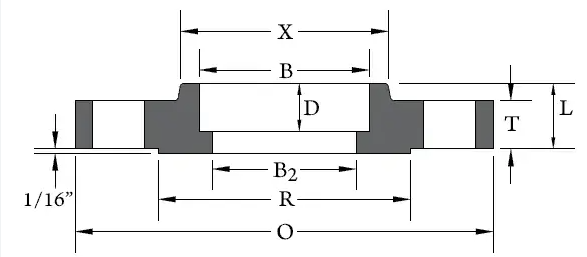
Nominal size is often stamped alongside da class, though not always, especially on smaller flanges where it is obvious. On reducing flanges you may see two sizes. On a flange with a non-standard bore, da bore may be called out separately. When da stamped size and your tape measure disagree, trust da tape and da dimensional tables. Our ASME B16.5 dimension reference lays out da OD, bolt circle, and bolt pattern for every size and class if you need to confirm.
The Marks That Trip People Up
Past da big four, a handful of marks carry real weight and get overlooked.
Da heat number is da long alphanumeric string dat looks like a serial number. It is not decorative. It ties da part back to a specific melt of steel and da Material Test Report dat documents dat melt's chemistry and mechanical properties. If you ever need to prove what a flange is made of, da heat number is da thread you pull. Lose it and you lose traceability.
On ring type joint flanges, you gonna see an "R" followed by a number, like R-37 or R-45. Dat is da ring groove number per ASME B16.20, and it tells you which RTJ gasket fits da groove. Da ring number is tied to da size and class combination, so it is a useful cross-check: if da R-number does not match what da size and class should call for, somet'ing is off. We cover dis in more depth in our guide to RTJ flanges.
Country of origin shows up on most imported flanges and increasingly on domestic ones too. On federally funded, municipal water, or military work, dat mark feeds straight into Buy American, BABA, and AIS compliance, and an inspector will look for it. Domestic-melt-and-manufacture parts are marked to prove it.
For sour service, da relevant detail usually is not a single stamp but da grade and a hardness limit. NACE MR0175 work requires da flange body at or below 22 HRC, and dat is verified by da MTR rather dan read off da OD. When sour service is in play, da stamp gets you to da grade; da documentation does da rest.
Common Flange Stamp Elements, Decoded
Mark on the Flange | What It Tells You | Example |
Manufacturer name or logo | Who forged it; trademark for traceability | Stamped logo or initials |
Material spec and grade | The steel and its certification path | SA-105, A182 F316L, A350 LF2 |
"S" prefix (SA vs A) | ASME code material vs general ASTM piping | SA-105 (code) vs A105 |
Pressure class | ASME B16.5 class designation, not PSI | 150, 300, 600, 900, 1500, 2500 |
Heat number | Ties the part to its MTR and melt chemistry | Long alphanumeric string |
"R" plus number | RTJ ring groove number per ASME B16.20 | R-37, R-45 |
Country of origin | Domestic vs import; AIS and BABA compliance | USA, or country name |
The Bottom Line
Readin’ flange markings is not guesswork once you know what each mark is for. Da manufacturer ID and heat number give you traceability, da spec and grade tell you da steel and its code path, da class and size place it in da dimensional tables, and da special marks handle ring fit, origin, and compliance. Decode all of it before a flange goes into service, and verify against da MTR when da application is critical.
If you're workin’ t'rough a pile of stamped flanges and somet'ing don't add up, or you need replacements with full documentation and da right marks da first time, get in touch with our team, y'all. We stock ASME B16.5 flanges across 50-plus grades and can confirm exactly what you're gettin’ before it ships.
Texas Flange & Fitting Supply | 281-484-8325 | texasflange.com