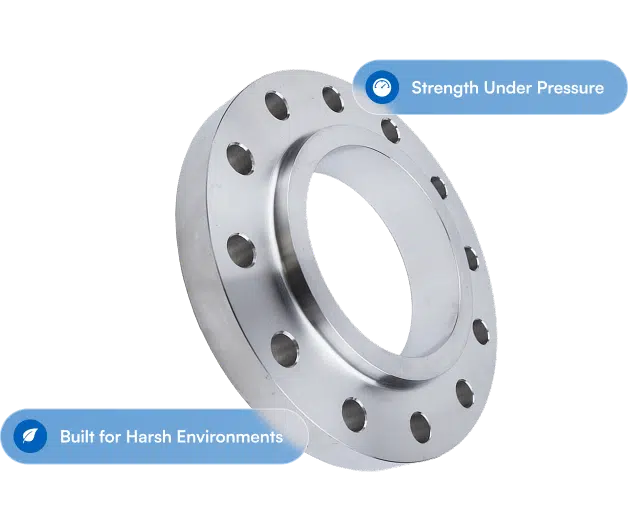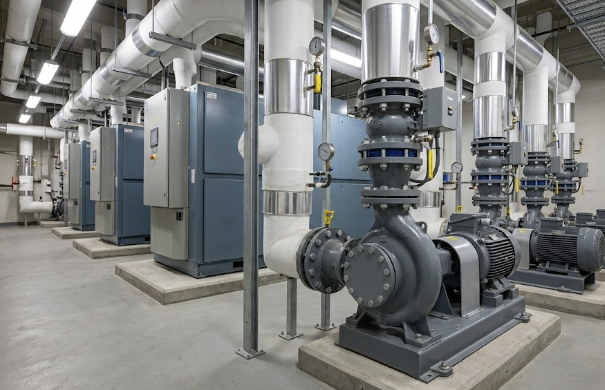
Walk into the mechanical room of any big buildin', an office tower, a hospital, a university hall, and you'll see the same components: chillers, pumps, a tangle of insulated pipe, and flanged joints ever' which way you look. Lotta dem things you might not even be able to name, even if you know what they look like. Nobody thinks about the flanges and fittings on this machinery till one of 'em weeps onto the housekeepin' pad. We all just expect this stuff to work, I reckon. The flange selection in a hydronic system ain't arbitrary, and a couple of 'em will crack expensive equipment if you end up pickin' the wrong ones. Gettin' the right BOM is key here.
Quick clarification before we get started, 'cause the word does double duty in this trade: this here's about the pipe flanges that join hydronic pipin' to pumps, chillers, and valves, and not so much the sheet-metal duct flanges that join air handlin' ductwork. Two different worlds in the same industry. Today, y'all, we're on the water side. (For the specific case of hyperscale data center coolin', which runs into much bigger diameters beyond a mechanical room, see our piece on flanges for data center cooling.)
The Systems, and Where Flanges Show Up
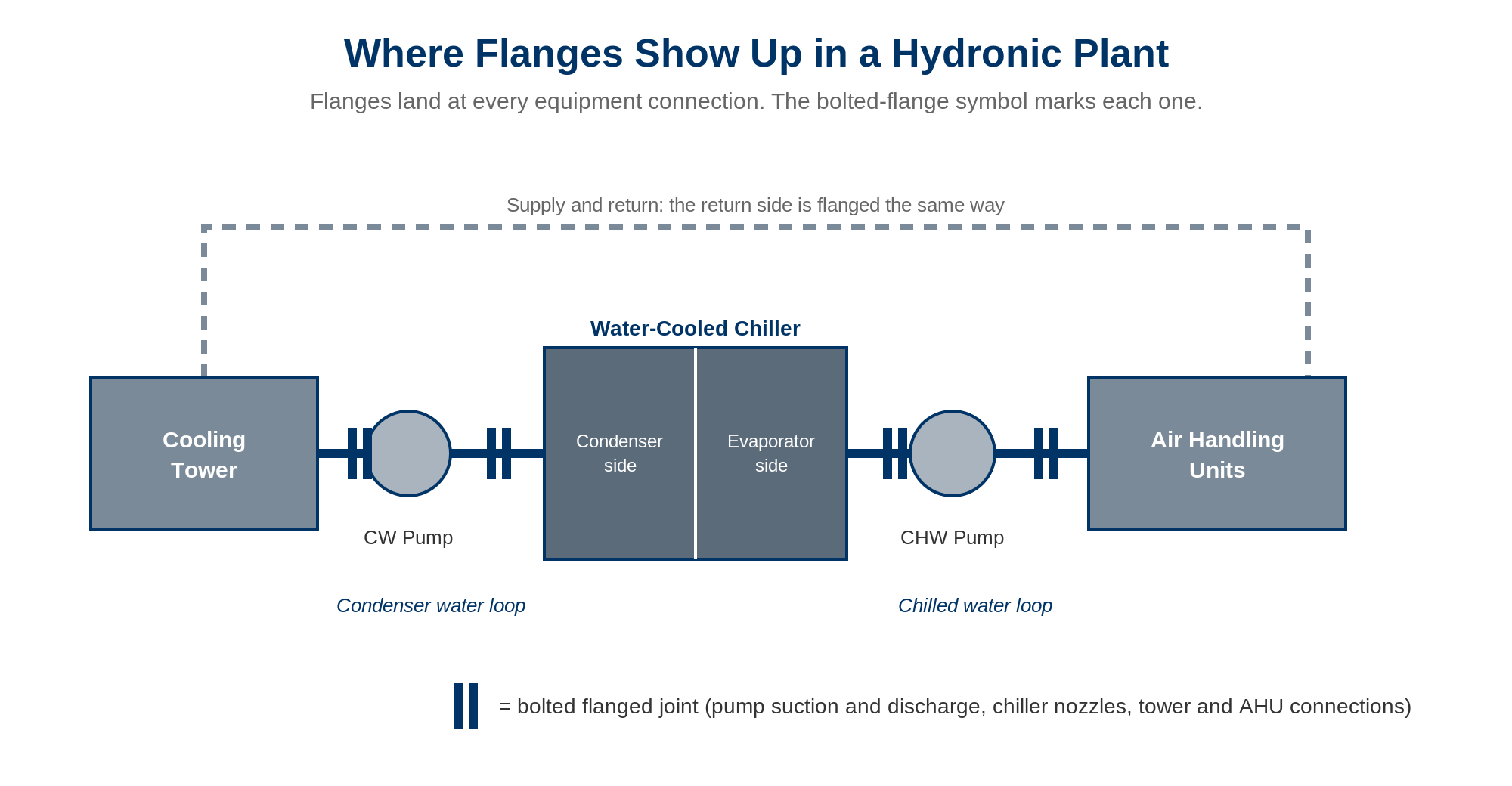
Commercial HVAC moves heat with water and sometimes steam. The main loops are chilled water (CHW) between the chillers and the air handlers, condenser water between water-cooled chillers and the coolin' towers, and hot water for heatin'. Each one is a closed or semi-closed pipin' circuit, and each one hooks up to rotatin' and heat-transfer equipment. The biggest components you can usually spot outside near a city center.
The flanges live at all of them connections. Pump suction and discharge, chiller evaporator and condenser nozzles, coolin' tower inlets and outlets, heat exchangers, big butterfly and triple-offset valves, strainers, and air separators all land on flanged joints once the pipe gets big enough, or when there's bends in the system to save space. Smaller branch pipin' is usually grooved, threaded, or soldered, but the mains and the equipment connections are where flanges do the work, typically anywhere from 3 inch on up through 24 inch and beyond on a big central plant.
Why Almost Everything Is Class 150
Here's the good news for HVAC procurement: the pressures are usually mighty low. A typical hydronic system runs well under 200 psi, so Class 150 flanges cover the overwhelmin' majority of the buildin'. Forged carbon steel, ASTM A105, in Class 150 weld neck or slip-on is the default across chilled water, condenser water, and even most heatin' hot water service. Some AWWA spec flanges work as well.
The exceptions are worth knowin'. A tall buildin' has real static head: the weight of the water column itself adds pressure at the bottom of the riser, and a high-rise pump system can push a low-zone connection past what Class 150 wants to see, which is why you'll now and then find Class 300 flanges specified down in the basement of a tall tower. Steam and high-temperature heatin' water also bump the class up. When in doubt, the operatin' pressure plus the static head, not just the pump ratin', sets the class.
The Cast Iron Trap
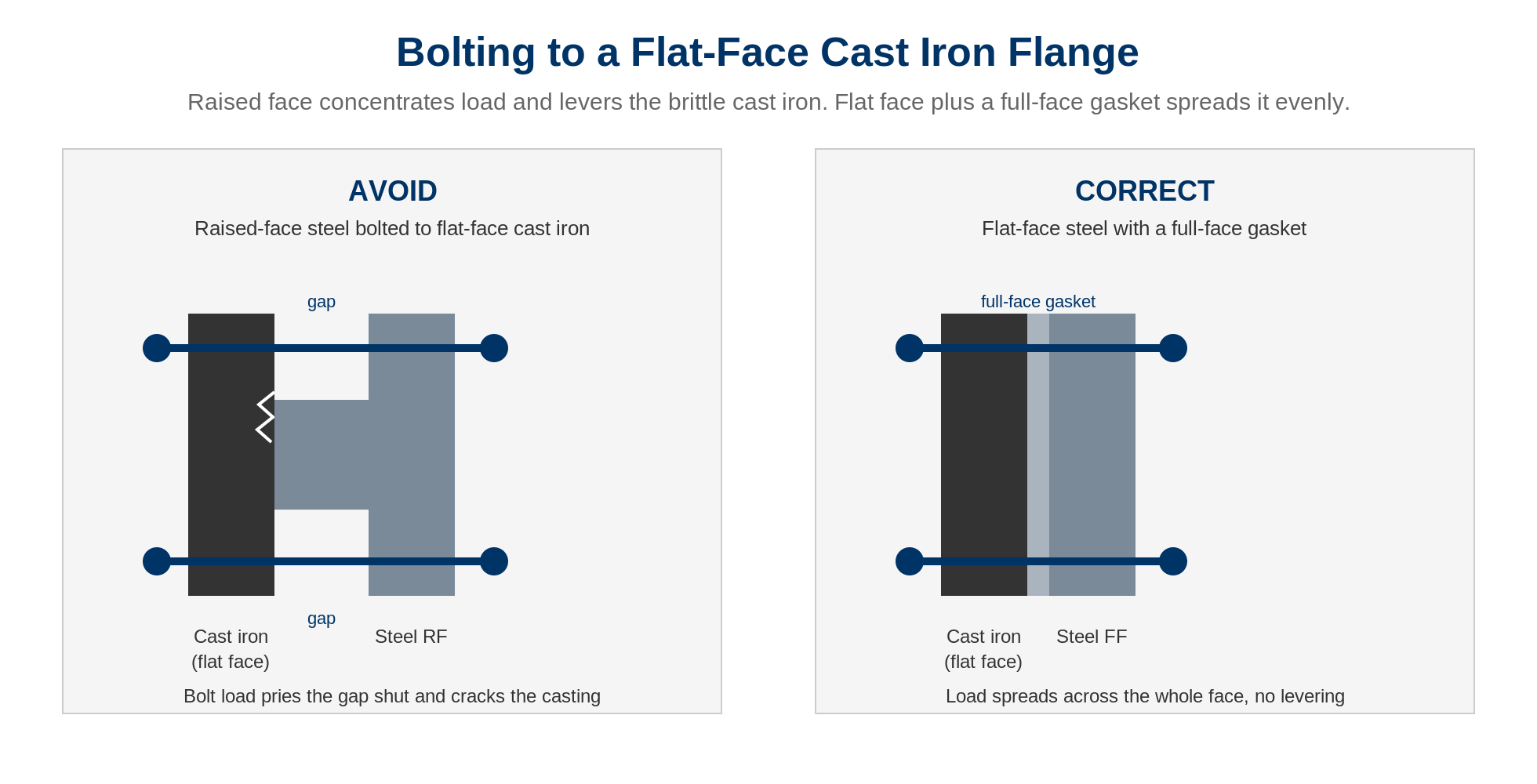
This here's the one that bites folks, and it's worth the whole section, I tell you what. Pumps, valves, and other equipment in HVAC are very often cast iron, and cast iron equipment flanges are flat faced, almost always to the old Class 125 cast iron bolt pattern, which happens to match Class 150 steel drillin'. The modern ASME B16.5 was born out of B16.1 where cast iron was common as dirt, and it ain't so popular these days with modern engineerin' standards.
The mistake is boltin' a standard raised face (RF) steel flange straight to that flat face cast iron. The raised face makes a little gap at the bolt circle, and as you torque them bolts down, that gap levers the brittle cast iron flange and can crack it. ASME B31.1 speaks to this directly: when you connect to a flat face cast iron flange, either take the raised face off the steel flange or, more practical, use a flat face steel companion flange with a full-face gasket so the load spreads even across the whole face. We get into the geometry of this in our raised face vs. flat face guide, but the rule for the mechanical room is simple as pie: cast iron equipment gets flat face steel flanges and full-face gaskets, not raised face.
Gaskets follow the same logic. Hydronic water service is usually sealed with non-metallic full-face gaskets in EPDM or a similar elastomer rated for the system temperature. Only a flat face gasket belongs on a flat face flange, yessir.
Slip-On or Weld Neck
Both show up in HVAC, and which style you pick is part cost, part spec. Slip-on flanges are cheaper, easier to fit up, and forgivin' on alignment, which makes 'em popular on low-pressure water systems where nobody's worried 'bout pushin' the pressure-temperature envelope. The welds on the hubs are simpler to manage than the buttweld configuration. Plenty of commercial hydronic jobs run slip-on flanges and never have a lick of trouble.
That said, some engineerin' specs don't allow slip-on at all and require weld neck, on the logic that weld neck gives a stronger, fatigue-resistant joint with a smoother flow transition. If you're buyin' to a spec, read it before you go assumin' slip-on is okay. Our slip-on vs. weld neck comparison lays out the trade-offs in detail.
A Quick Reference for the Mechanical Room
Connection or System | Typical Flange | Notes |
Chilled / condenser / hot water mains | Class 150 A105, weld neck or slip-on | Low pressure; Class 150 covers most service |
Cast iron pump or valve body | Flat face steel, full-face gasket | Never bolt RF to flat face cast iron |
High-rise low-zone connections | Class 150 or 300 | Static head can push class up at the base |
Steam / high-temp heating | Class 150 or higher | Pressure and temperature drive the class |
Small branch piping | Often grooved/threaded | Flanges appear as pipe size grows |
The Bottom Line
HVAC ain't high-pressure refinery work, and the flange spec shows it: mostly Class 150 carbon steel, sealed with elastomer gaskets, joinin' a buildin's water loops to its big equipment. The two things that actually cause callbacks are missin' the cast iron rule and assumin' slip-on is allowed when the spec says weld neck. Get them two right and the rest is routine, y'all.
If you're buildin' out a chilled water plant or a hydronic retrofit and want the flanges, faces, and gaskets matched to the equipment the first time, send us the equipment schedule and pipe sizes. We'll get you the right Class 150 flanges, flat face where the cast iron demands it, with gaskets to match, right quick.
Texas Flange & Fitting Supply | 281-484-8325 | texasflange.com