Ever' headline 'bout the AI buildout talks 'bout chips, megawatts and land. Hardly a one talks 'bout the part that keeps the whole shebang from meltin': water, and the miles of large-diameter pipe that moves it. Dat pipe is flanged, and dat's where this quits bein' somebody else's news story and starts bein' ours.
Dem numbers ain’t exactly small potatoes. U.S. data centers used an estimated 21 billion liters of water directly in 2014 and roughly 66 billion liters by 2023, and the AI surge has only made the curve steeper since. Data center capital spendin’ is now runnin’ well past half a trillion dollars a year, with 2026 projections climbin’ toward $800 billion. A growin’ share of dat spend is cooling infrastructure, and most new hyperscale builds announced over the past two years now specify direct-liquid-cooling-ready systems as a baseline requirement, since other methods ain’t as practical. All dat heat’s gotta go somewhere, and dat somewhere is a water loop piping system.
Why Coolin' Is a Piping Problem
A modern AI hall can pack racks pullin' more power than a whole legacy data center floor. Air by itself can't carry dat heat away, which is why the industry's movin' hard toward liquid cooling: direct-to-chip cold plates, rear-door heat exchangers, and sometimes immersion. But liquid cooling at the chip is just the last few feet. Behind it sits a building-scale water system: chilled water loops, condenser water loops, cooling towers, and the headers dat tie 'em all together.
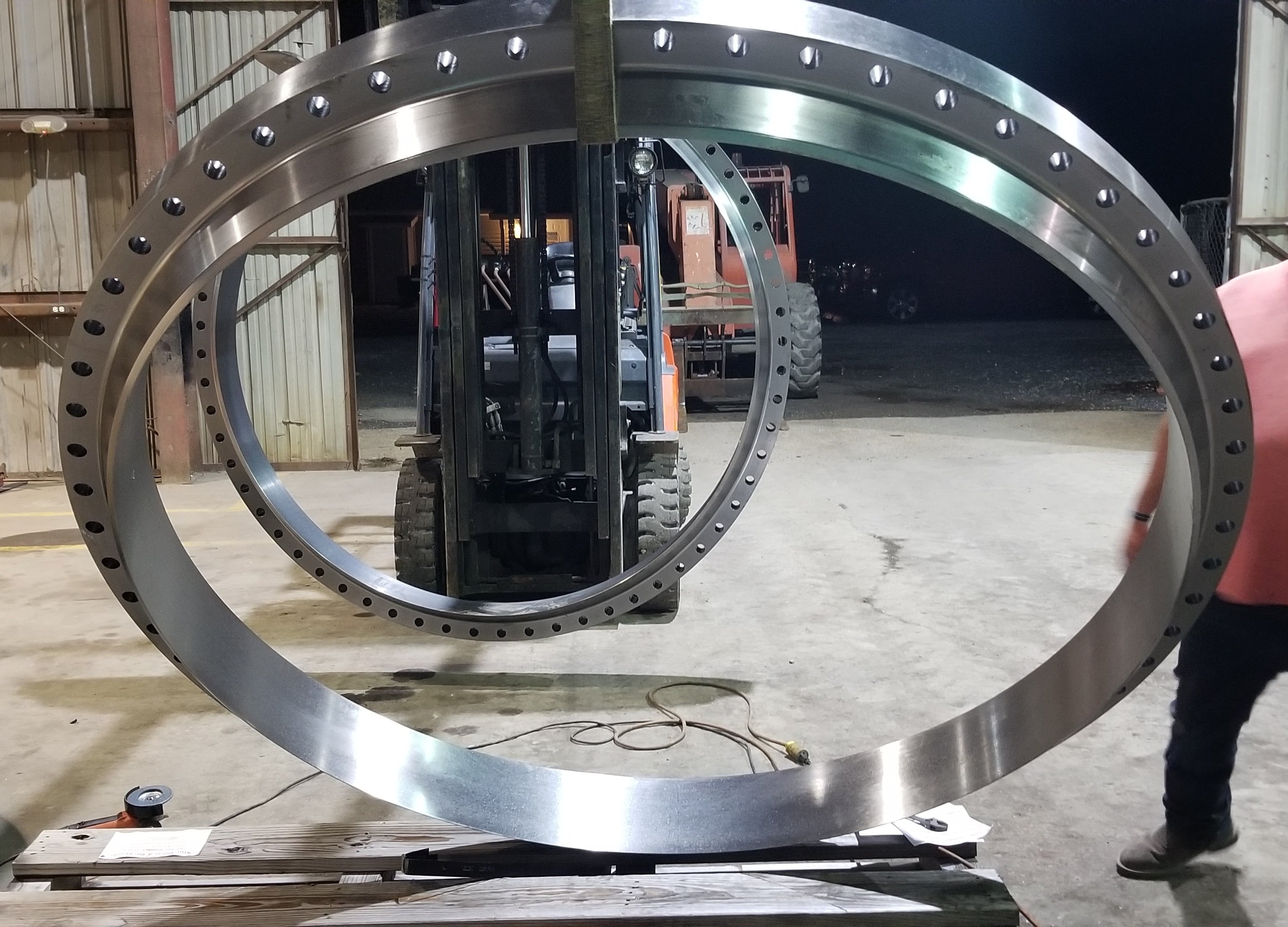
Dem headers ain't made like your run-of-the-mill garden hose. To move thousands of gallons per minute, main distribution lines commonly run between 18 to 48 inches in diameter, with secondary branches scalin' down to 4 inches and smaller usin' piping reductions. Ever' place two of dem pipe sections meet a valve, a pump, a chiller or each other, there's a flanged joint. One big facility might be runnin' thousands of 'em.
Two Loops, Two Sets of Specs, Yessir
The water side of a data center generally splits into two systems, and dey don't spec out the same way, I tell you what.
The chilled water loop is the closed side. It circulates treated water (often with glycol and corrosion inhibitors) between the chillers and the cooling equipment near the racks. 'Cause it's closed and the water's conditioned, corrosion gets managed and the pressures stay modest. Most chilled water loops run well below 150 psi, so dey call for low pressure flanges.
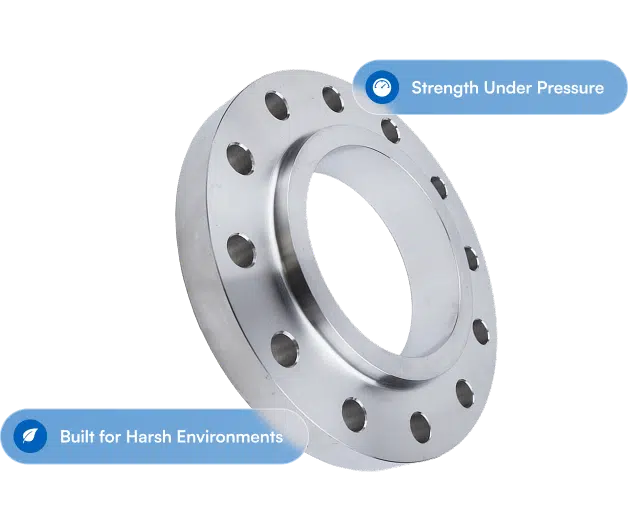
The condenser water loop dumps heat to the cooling towers. It sees more oxygen, more makeup water and rougher conditions, so pickin' your material matters more here. Condenser systems are often built from modern piping to ANSI/AWWA C150/A21.50 and C151/A21.51, joined with Class 150 forged carbon steel weld neck flanges in ASTM A105. The same weld neck flanges dat show up in any process plant are doin' the work here too.
Where AWWA Flanges Come In, friend
Dis is the part procurement teams miss till the submittals come back. A whole lot of the large-diameter water side of a data center don't need to be B16.5 per ASME, but waterworks spec instead. Dat means AWWA flanges, and most often AWWA C207 or C228. In dat case, a 20” weld neck might get swapped out for a 20” AWWA ring flange.
For chilled water service, AWWA C207 Class D, rated for 150-175 psi, is the common pick. The logic's simple: the loops run a little closer to atmospheric pressure, so Class D carries a comfortable safety margin while keepin' cost and weight reasonable on big 24, 36 and 48 inch headers. It's built for exactly dis kind of continuous-duty, closed-loop water service. The class-by-class detail of C207 (B, D, E, F, and where each one belongs) is its own conversation, and one we'll walk through in a dedicated post. For the data center buyer, the long and short of it is dat the cooling loop pulls you into the AWWA world, not just the ASME one, and the two got different drilling, ratings and tolerances.
What This Means If Y'all Are Buyin'
The data center build cycle is fast and don't forgive nothin'. Pipe and flange packages get ordered against aggressive schedules, and a mismatch 'tween an ASME drilling and an AWWA bolt pattern, or a wrong class on a 36 inch header, ain't no quick fix at dat size. A few things worth nailin' down early:
Decision Point | What to Confirm | Common Data Center Answer |
Which loop | Chilled (closed) vs. condenser (open) | Different material and corrosion needs per loop |
Standard | ASME B16.5 vs. AWWA C207 | Large-diameter water side is usually AWWA |
Pressure class | Actual operating pressure vs. rating | C207 Class D (150 psi) common for chilled water |
Size range | Header vs. branch | 18 to 48 inch headers, down to 4 inch branches |
Material | Carbon steel, ductile iron, coatings | A105 weld neck, ductile iron to C150/C151 |
Lead time | Large-diameter availability | Big flanges are not always shelf stock |
The large-diameter end of dis is where projects get caught. A 48 inch flange ain't something most suppliers keep heavy stocked in their inventory on account of spacin' constraints, and the data center pipeline's competin' for the same capacity as ever'body else, vessel manufacturers and even municipal water supplies included. Confirmin' size, class, standard and material before the schedule locks is the difference 'tween a loop that bolts up and a delay on the critical part of your project.
The Bottom Line, Y'all
The AI story is a water story, and the water story is a flange story. Hyperscale cooling is pullin' enormous volumes of large-diameter, flanged pipe into the market, splittin' buyers 'tween ASME process flanges and AWWA waterworks flanges dependin' on the loop. The plants dat get ahead of it are the ones treatin' the cooling system like the heavy industrial piping project it really is, not an afterthought to the server order.
If y'all are scopin' a cooling loop or pricin' large-diameter headers and want to get the standards and lead times right the first time, holler at our team. We stock and make both ASME and AWWA flanges in the big sizes dese projects run on, from 4 inch branches to headers most suppliers won't even quote.
Texas Flange & Fitting Supply | 281-484-8325 | texasflange.com