Companion Flanges
The no-weld way to put a bolted, flanged joint on threaded pipe. Here is what a companion flange is, where it earns its place, and the numbers you need to spec one correctly the first time.
What Is a Companion Flange?
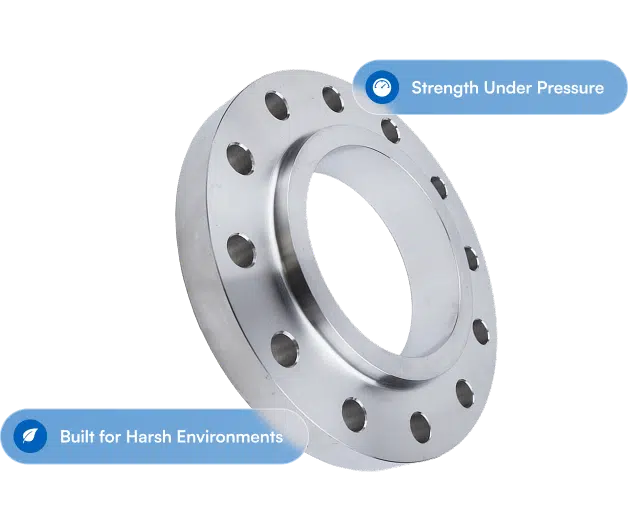
A companion flange is the flange that pairs with a mating flange to close a bolted joint. In the flange supply world the term almost always means a threaded flange: a flange machined with internal NPT threads per ASME B1.20.1 that screws directly onto threaded pipe. Add a gasket and a set of bolts, and a threaded line becomes a flanged connection without a single weld.
That is the whole reason the part exists. Valves, pumps, meters, and strainers ship with flanged ends, while a great deal of small-bore utility, municipal, and commercial pipe runs on threads. The companion flange is the adapter that brings the two together, and as long as it was not seal-welded and the threads remain serviceable, it unbolts and unthreads just as cleanly when the equipment comes out for service.
One caution on the name. The driveline world uses “companion flange” for the part that couples a driveshaft to a differential. Same two words, different universe. Everything on this page is pipe flanges.
How the Joint Goes Together
The companion flange threads onto the pipe, a gasket seats against the mating flange, and bolts pull the joint tight. No weld is needed to assemble it. A seal weld at the thread is optional, is hot work, and gives up the unthread-later benefit.
When a Companion Flange Is the Right Call
Three situations put a threaded companion flange at the top of the list:
No hot work permitted. Occupied buildings, water and wastewater plants, and classified areas where a hot-work permit is its own paperwork project. Threads make the joint cold, so the line goes together with a pipe wrench instead of a welding machine.
Flanged equipment on threaded pipe. Meters, pumps, check valves, and butterfly valves arrive with flanged ends and need a mating flange to land on. A companion flange adapts the existing threaded run in minutes, no bevel prep and no welder on site.
Built to come apart. Seasonal irrigation headers, rental and skid equipment, and temporary process tie-ins that are meant to be disassembled on a schedule. Unbolt it, unthread it, and reuse it next season.
On assembly, make the threads up with a suitable thread compound or PTFE tape and follow ASME B1.20.1 engagement practice. And know when to reach for something else: severe cyclic, high-temperature, Category M or lethal, and high-vibration service is weld neck or socket weld territory, not threaded.
Companion vs. Other Flange Connections
How a flange attaches to the pipe drives everything downstream: install cost, pressure ceiling, and how the joint holds up over years of service.
| Flange Type | How It Attaches | Welding Required | Where It Fits |
|---|---|---|---|
| Threaded Companion | Threads onto NPT pipe | None to assemble; optional seal weld (hot work) | Small-bore, low to moderate pressure, no-weld areas |
| Slip-On | Slides over the pipe end | Two fillet welds, inside and out | General service; easier fit-up than weld neck |
| Socket Weld | Pipe drops into a bored socket (~1/16" gap) | One external fillet at the hub, per WPS | Small-bore (typically NPS 2 and under) at higher pressure |
| Weld Neck | Butt-welds to the pipe bevel | Full-penetration weld | High pressure, high temperature, critical service |
Each type has its own page in detail: slip-on, socket weld, weld neck, and threaded.
Class 150 Threaded Companion Flange Dimensions
Selected ASME B16.5 Class 150 dimensions in inches. A threaded companion flange sits in the standard B16.5 envelope, so it bolts to any matching flange of the same size and class regardless of how that mate attaches to its own pipe.
| NPS | Flange OD | Bolt Circle | Bolts | Bolt Size | Min. Flange Thickness |
|---|---|---|---|---|---|
| 1/2" | 3.50 | 2.38 | 4 | 1/2" | 0.44 |
| 1" | 4.25 | 3.12 | 4 | 1/2" | 0.56 |
| 2" | 6.00 | 4.75 | 4 | 5/8" | 0.75 |
| 3" | 7.50 | 6.00 | 4 | 5/8" | 0.94 |
| 4" | 9.00 | 7.50 | 8 | 5/8" | 0.94 |
| 6" | 11.00 | 9.50 | 8 | 3/4" | 1.00 |
Representative values. Verify against the current edition of ASME B16.5 for the applicable size, class, and material group. Need the full set? Our flange dimensions and weights reference has every class and size, our Class 300 dimensions cover the next class up, and our flange size chart guide walks through how to read the tables.
Pressure Ratings and Limits
Class 150 and Class 300 cover nearly every companion flange application. For A105 carbon steel (Material Group 1.1), ASME B16.5 rates Class 150 at 285 psig and Class 300 at 740 psig at ambient temperature, and both ratings step down as service temperature climbs. For a stainless or alloy companion flange, read the rating from the B16.5 pressure-temperature table for that material group, not the A105 numbers.
The threads set the ceiling, not the flange body. NPT engagement thins the effective pipe wall and can weep under vibration or thermal cycling, so a threaded companion flange is rarely the right call for severe cyclic, high-temperature, Category M, lethal, or high-vibration service, and codes derate threaded joints in the higher classes. Where the code or owner requires extra leak integrity, a light seal weld may be added after makeup; it is optional, it is hot work, and it limits future disassembly. A seal weld improves sealing but does not give the joint weld-neck strength.
The practical rule: keep threaded companion flanges on small-bore lines at moderate pressure and temperature, and move to socket weld or weld neck when the service turns severe. Larger threaded flanges are dimensionally possible but are rarely stocked above about NPS 3 to 4, so plan on welded types for big bore. If you are weighing the trade-offs, our flange buyer's guide lays out the full decision path.
Face types follow the same rules as any B16.5 flange. Raised face is the default, flat face mates to flat-faced equipment like cast iron pump housings, and a flat-face joint always takes a full-face gasket.
Common Materials
| Material | Grade | Typical Service |
|---|---|---|
| Forged Carbon Steel | ASTM A105 | General process, water, air, and oil and gas utility lines |
| Stainless Steel 304/304L | ASTM A182 F304/F304L | Corrosive service, food and beverage, water treatment |
| Stainless Steel 316/316L | ASTM A182 F316/F316L | Marine, chloride exposure, chemical service |
| Galvanized Carbon Steel | A105, hot-dip galvanized after machining | Outdoor, municipal, and irrigation systems |
Galvanizing is a finish applied after machining, not a pressure grade; the rating comes from the base steel. Cast iron and bronze companion flanges live in the plumbing trade, while industrial lines run on forged steel and stainless in the grades above.
Since 1986, Texas Flange has kept companion flanges on the shelf in carbon steel, stainless, and galvanized, alongside the full range of ASME B16.5 flange types. Send us your size, class, and material and we will quote it, ready to ship from stock.