If you’ve ever needed to measure flow in a pressurized piping system, chances are someone pointed you toward an orifice flange. These flanges are purpose-built for flow measurement, and they do one job extremely well: giving you clean access to differential pressure readings, with or without an orifice plate segment. Orifice sets are some of those components that seem simple until you spec the wrong ones, and then you’re dealing with inaccurate readings, leaks, or a shutdown to fix it.
Here’s what you need to know about orifice flanges, from how they work, to how to pick the right one for the job.
How an Orifice Flange Works
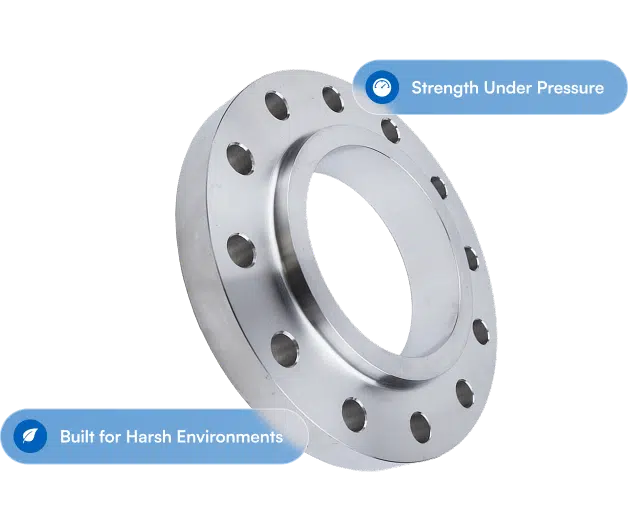
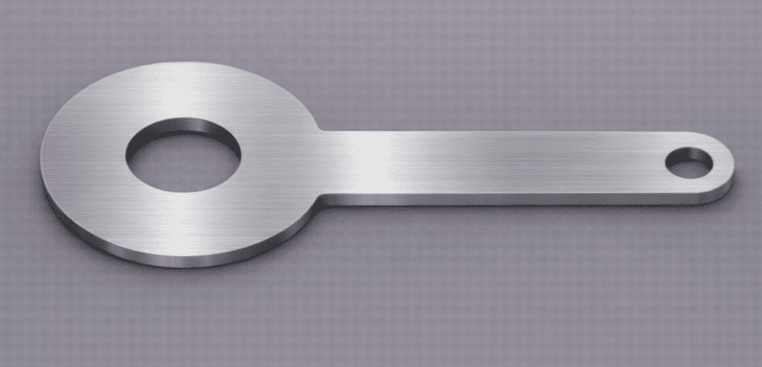
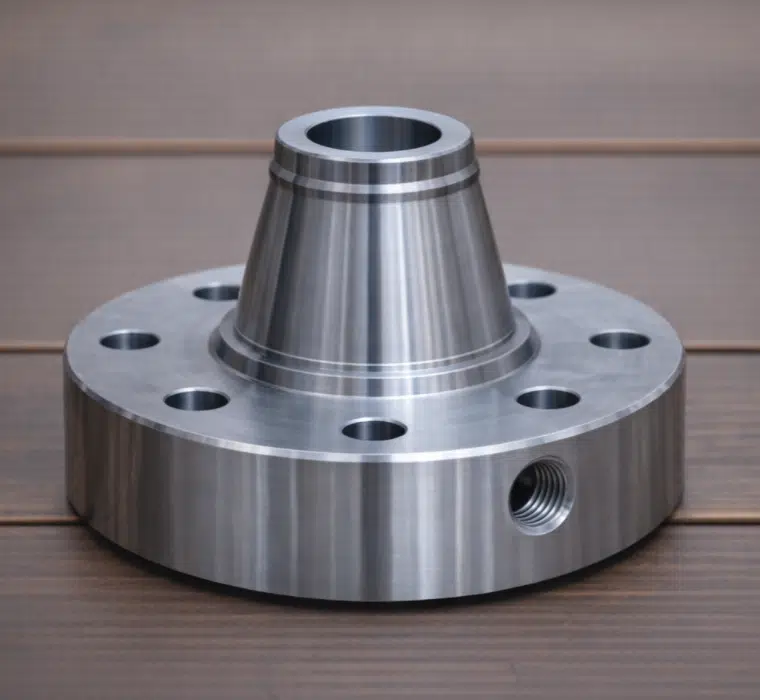
An orifice flange looks similar to a standard weld neck flange, but with one critical difference: it has one or two tapped holes (pressure taps) drilled radially through the base. These taps are positioned on either side of a thin orifice plate that sits between a mated pair of orifice flanges. The orifice plate has a precisely sized bore that restricts flow, creating a measurable pressure differential across the plate.
The upstream tap reads the higher pressure before the restriction, and the downstream tap reads the lower pressure after flow passes through the orifice bore. That differential, combined with the known bore diameter and pipe dimensions, lets instrumentation calculate the flow rate. It’s the same principle behind Bernoulli’s equation, applied to a real piping system.
This design is governed by ASME B16.36 (Orifice Flanges) and its correlation to B16.48, which defines dimensions, tolerances, pressure/temperature ratings, and tapping specifications. For the flow measurement methodology itself, refer to something like API 2530 or ISO 5167, depending on your project requirements.
Types of Orifice Flange Assemblies
Orifice flanges come in a few configurations depending on the installation needs and how the orifice plate is held in place.
Orifice Flange Pairs (Weld Neck Orifice Flanges): The most common setup. Two weld neck orifice flanges are welded into the pipeline, bolted face-to-face with the orifice plate sandwiched between them. Each flange has a pair of jack screws that allow you to spread the flanges apart for plate removal and inspection without cutting the line.
Slip-On and Threaded Orifice Flanges: Available for lower-pressure, non-critical applications. These follow the same tapping conventions but use slip-on or threaded connections instead of weld neck hubs. Less common in refinery work, but they show up in utility and water applications where ASME B16.5 Class 150# and 300# ratings are sufficient. They also reduce space requirements given the shorter hub lengths.
When to Specify an Orifice Flange
Key Considerations for Selecting an Orifice Flange
Understanding the Importance of Orifice Flange in Flow Measurement
Orifice flanges are the right call when you need permanent, inline flow measurement with a differential pressure device. Common scenarios include:
Custody transfer metering in oil and gas pipelines, where accurate flow data is literally money. Refinery process control, where operators need real-time flow data to manage unit operations. Boiler feedwater measurement in power generation. And water and wastewater treatment facilities measuring throughput per AWWA and municipal requirements.
If your application calls for a Venturi tube, flow nozzle, or other DP-based measurement, the orifice plate and flange combination is usually the most cost-effective and easiest to maintain. The key advantage is that you can pull and inspect or replace the orifice plate without cutting pipe, as long as the jack screws on the orifice flanges are functional.
Orifice Flange Pressure Tapping Locations
The location of the pressure taps on an orifice flange matters for measurement accuracy. ASME B16.36 defines the standard tapping location, but you’ll encounter different conventions depending on the applicable measurement standard.
Flange taps (the most common): Pressure taps are drilled about 1 inch from each face of the orifice plate. This is the default for ASME B16.36 orifice flanges and the most widely used configuration in North America per AGA Report No. 3/API 2530.
Corner taps: Taps are located immediately adjacent to the orifice plate faces. More common in European practice per ISO 5167.
D and D/2 taps: The upstream tap is one pipe diameter (D) upstream, and the downstream tap is at D/2 downstream. These are pipe taps, not flange taps, and use a different installation approach.
Sizing and Pressure Class Selection
Orifice flanges follow the same pressure/temperature rating system as standard ASME B16.5 flanges, but they omit class 150# due to the lack of base thickness. They can be found in 300#, 600#, 900#, 1500#, and 2500#. Size range typically runs from 1″ through 12″ for standard ASME B16.36 configurations.
Orifice Flange Specifications at a Glance
| Specification | Details |
| Governing Standard | ASME B16.36 |
| Size Range | 1″ through 24″ (larger available as specials) |
| Pressure Classes | 300#, 400#, 600#, 900#, 1500#, 2500# (class 150# not available) |
| Common Materials | A105 (carbon steel), SA-182 F304/F304L, SA-182 F316/F316L, A350 LF2 |
| Facing Options | Raised Face (RF), Ring Type Joint (RTJ) |
| Tap Size | 1/2″ or 3/4″ or 1″ NPT (ASME B16.36 standard) |
| Flow Standard | API 2530 / ISO 5167 |
| Key Feature | Jack screws for plate removal without line cutting |
When sizing, the bore of the orifice plate (the beta ratio, which is the plate bore divided by the pipe inside diameter) determines the measurable flow range. A beta ratio between 0.3 and 0.7 is typical for most applications, per API 2530 guidelines. The flange size matches the pipe size, and the orifice plate is machined to the required beta ratio for the specific flow conditions.
Material Selection for Orifice Flanges
Material choice follows the same logic as any other ASME flange, but the orifice plate material also needs consideration since it contacts the process fluid directly.
Carbon steel (A105/SA-105): The workhorse for general service in oil, gas, and petrochemical. Good for temperatures from -20F to 800F depending on the class.
Stainless steel (SA-182 F304/F304L, F316/F316L): Required for corrosive service, food-grade applications, or where process cleanliness matters. F316L is the go-to for chloride environments, and for marine spec.
Low-temperature carbon steel (A350 LF2): For services below -20F. Common in LNG, cryogenic, and cold-climate pipeline applications where Charpy impact testing is required per ASME specifications.
Chrome-moly alloys (SA-182 F11, F22, F91): High-temperature service in power generation and refinery applications. Match the alloy grade to the piping system’s design temperature and ASME code requirements.
Worth noting: the orifice plate itself is often 316 stainless steel even in carbon steel systems, to keep the bore edge precise over time.
Common Mistakes When Ordering Orifice Flanges
A few things that trip people up when specifying orifice flanges:
Not specifying the tap orientation relative to the pipeline. The taps need to be oriented correctly (typically on the horizontal centerline for liquid service, top of pipe for gas service) to get accurate readings and avoid issues with condensate or entrained gas in the impulse lines.
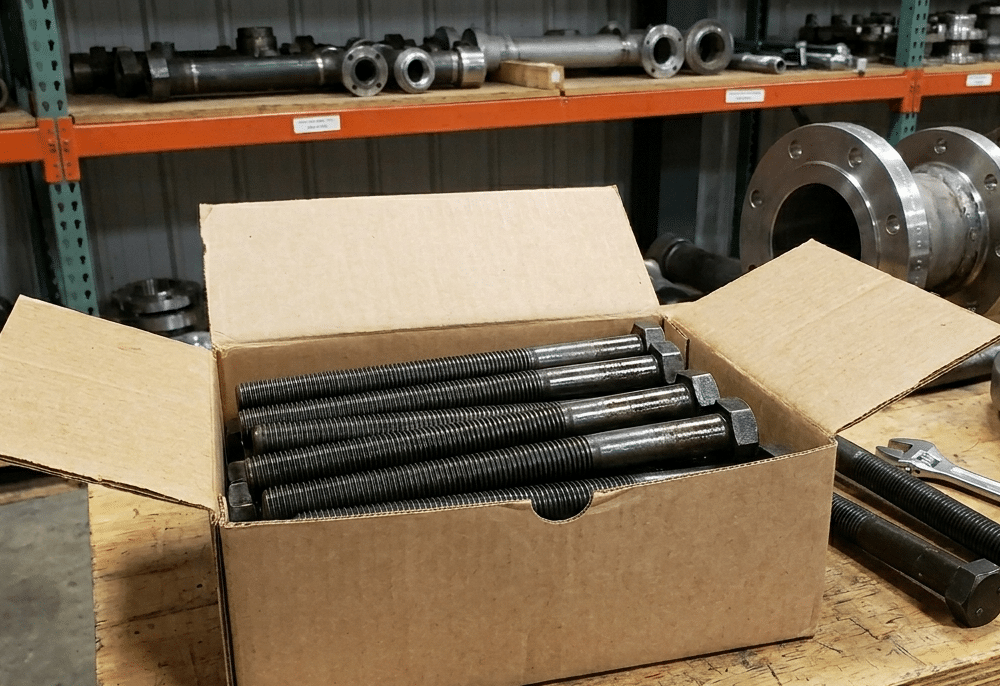
Forgetting the jack screws. Standard orifice flanges per ASME B16.36 include jack screw holes, but if you order a generic “weld neck with taps drilled” from a shop that doesn’t know the spec, you may end up without them. Jack screws are not optional for field serviceability.
Ordering the wrong tap size or location. If your instrumentation package calls for specific tap dimensions or a non-standard tap location, call that out on the purchase order. The default per ASME B16.36 is ½” or 1″ NPT flange taps, but project specs can vary.
Get the Right Orifice Flange the First Time
Orifice flanges are precision components disguised as standard piping hardware. The dimensions, tapping, and material all need to line up with your flow measurement requirements, or you end up with readings you can’t trust. It pays to get the spec right from the start.
If you need orifice flanges in any size, class, or material, get in touch with Texas Flange and we’ll get you quoted fast. For more on selecting flanges for high-pressure service, check out our post on choosing the right flange for high-pressure systems.
Texas Flange & Fitting Supply | 281-484-8325 | texasflange.com